Feed on
Posts
Comments

Why are so many people unhappy in their relationship?

That’s a hard question to answer, although that doesn’t stop people from trying to figure it out.

According to Dana Adam Shapiro’s research for his book You Can Be Right (or You Can Be Married), very few married people are happy — he says about 17 percent. What derails their marriage? A lack of communication, dishonesty and adultery are among the top problems, he notes.

One poll finds that about six in 10 of us are unhappily coupled, four out of 10 say they have considered leaving their partner and one in 10 don’t even trust their partner anymore.  Unhappy marriage

Why?

The poll goes on to detail the most-mentioned problems, the top five being lack of spontaneity, lack of romance, terrible sex life, no time to give each other attention and lack of time to talk.

Instead of a poll, I thought I’d venture over to the Experience Project to read the real-person responses to a question — why are so many people unhappy in marriage?

Here are snippets of the 140 answers:

  • Finances and unmet expectations.
  • marriage isn’t natural. It isn’t really natural for a person to WANT to be permanently bonded to someone, with no real option of getting out (without a lot of trouble). Society and cultural norms and history have made marriage something that seems totally normal, when in reality, only certain types of people and certain types of personalities are going to be naturally able to make marriage work. Everyone else is going to have to work at it.
  • people getting married when they shouldn’t: too early, not compatible, etc. If you’re bored after a few years of marriage it’s definitely not gonna work. A real lifelong relationship should have many stages
  • I’ve been against marriage because I had the idea that my parents are suffering so much in it and I hated the idea of being so miserable. The funniest thing is that they actually get along really well, the problem was in the image movies and fairytales give about marriage — happily ever after, endless romance etc.
  • I suspect that a large chunk of the unhappiness can be traced back to dubious reasons for getting married in the first place. That is, the foundation of the troubled relationship is fragile and built on superficialities such as watching the same shows, loving the same favorite band, or even the theatrics of having a wedding itself.
  • if more marriages are failing right now, I’d say the number one cause is our lack of knowledge of how to built and maintain one — not that we aren’t suited for it.
  • Because people don’t want to accept that relationships are work
  • people just assume too much … they fill in the blanks with what they want to believe rather than having the hard conversations to find out for sure … or they don’t know themselves well enough to be able to answer truthfully if the right questions are asked
  • If they view a relationship as the end result goal in itself, rather than a beginning of new types of opportunity, then what?
  • People are unhappy in marriage because they do it for the wrong reasons. If you choose to be married, you have to maintain your own identity and be willing to communicate and make known what your needs and wants are and be willing to listen to those of your spouse. It isnt all about you, you need to compromise, but at the same time know what your boundaries are and be comfortable enough to be able to stay true to who you are while allowing someone else in. Its difficult, Its work.
  • not all people are cut out for marriage in the first place, even if they take the time to make things work. Some people seem to have this natural resilience, where they can remain faithful and loyal to one person without becoming extremely bored, so that their eyes aren’t wandering. Other people seem less resilient by nature and just give in to feelings of boredom and discontentment, as perhaps they need more than one person every few years. For these people, marriage just isn’t something for them. It’s a social construct which merely forces them to suppress their natural tendencies and feel socially inadequate.
  • It sounds cliche, but I think that if both people had great relationships with themselves before they got married, their would be a better chance the relationship would work out. If you depend on someone else to make you feel complete, when they don’t live up to your expectation, you will just end up resenting them, when really it is your own issue.
  • I find that communication is a huge factor in any relationship and I think the lack of communication along with finances, stress, infidelity and any sort of negativity can ruin a marriage in a heartbeat
  • There’s so much societal pressure to have a bf/gf as a means to validation and self-worth that it’s not hard to figure out how horrible marriages result.
  • A society that teaches independence instead of interdependence and also, teaches that emotional vulnerability is a weakness
  • if a couple told me they’re married I subconsciously question how much of the relationship was based on freewill versus societal and parental pressures/expectations
  •  in a lot of cases, a person will try to alter their partner, who they see as kind of fitting the mold of their “ideal partner”, they just need a little bit of fixing and it will make them both happier.

You’ll find similar responses over at City-Data Forum, along with, “My spouse is more like a room-mate (friend, maybe, I’m not sure) than a lover these days. We just exist in the same house, and that’s it.

So, we have the whole shebang — unrealistic expectations, including a need for “romance,” communication issues, societal and internal pressures and the lack of knowledge of how to maintain a healthy marriage.

Which brings up the question of whether we are expecting our relationship to make us happy, or whether we are bringing our happiness into our relationship. I wish it were as simple as that, but it appears to be much more complex; even happy people with fulfilling lives can marry and find out that they made a mistake — and then feel trapped in a marriage that crushes their spirit.

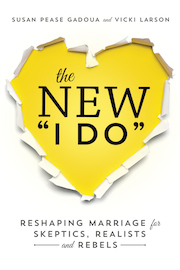
What Susan Pease Gadoua and I are trying to do in our book, The New I Do: Reshaping Marriage for Cynics, Commitaphobes and Connubial DIYers, is get people to marry more consciously and avoid these problems, plus create marital models that set them up for success. As Shapiro says:

“I don’t think a marriage that ends in divorce is a failure. It could be good, loving, you raise kids together, and maybe 20 years down the line it’s not working, and that’s okay.”

We’re saying that, too.

Beyond that, I do think people need help understanding how to maintain a healthy relationship for the long haul. We are able to do that with friends — generally. Can we glean things from those relationships to make our romantic relationships work better? And that might be related to what someone notes above — our society encourages independence, and that creates conflict with intimacy (which Andrew Cherlin explores in his book, The Marriage-Go-Round).

  • Why do you think so many people are unhappily coupled?
  • How would you solve that dilemma, if it’s even able to be solved?


Photo © Iban Salvador/Fotolia.com

Share

Tags: , , , , , , , ,

Gwyneth Paltrow — the most beautiful woman in the world, according to People — confessed to what Ben Affleck admitted a few months ago — marriage is hard and it takes work.

“It’s hard being married. You go through great times, you go through terrible times. We’re the same as any couple,” Paltrow said of her nine-year marriage to Coldplay lead singer Chris Martin.

It isn’t much different from what Affleck said of wife Jennifer Garner while accepting his Oscar for Argo, “I want to thank you for working on our marriage for 10 Christmases. It’s good. It is work but the best kind of work and there’s no one I’d rather work with,” which caused a bit of a kerfuffle. Marriage is work

Why do so many believe marriage is “hard” and “work”? And why does the idea of marriage being “hard” or “work” cause so many to get incensed?

Marriage is only hard if it’s a bad marriage, someone Tweeted me.

Then, CafeMom Sasha Brown-Worsham wrote, no, marriage isn’t “hard” — it’s “challenging:”

Marriage is so many things at so many different times. It can be hilarious, wild, sexy, frustrating, boring, exciting, and productive and then suddenly turn on its head and be 15 other things all at once. But the one thing almost everyone tells brides-to-be and women in general is that marriage is “hard.” I am not sure I would agree, though.

I guess it really depends on your definition of “hard.” It can be challenging, but many good things are. Sometimes compromise can be a bummer and you would really rather do your own thing. Sometimes sharing the remote is depressing when you would rather watch your own show, but I would never say that marriage itself is “hard. … Saying it’s hard somehow implies that it isn’t worth it or that there are many parts of it that are bad. I disagree. Why would anyone stay in a marriage that feels like drudgery and makes you unhappy?

(If you want to know judgment, just try telling others you want to get out of a marriage because it “makes you unhappy”!)

But, really, “hard” or “challenging” — is it all about semantics?

Marriage never used to be considered work; marriage was considered a duty, which I’ve written about before. I’m not sure that’s any better, because duty implies there’s no choice and we certainly like choice in marriage nowadays. But along with the rise of marriage counseling came the idea that marriage is work — and that it’s mostly the wife’s job to do it — and the rise of “professionals” and “relationship experts” and an entire self-help industry to help us with that.

Which makes me re-examine my own two marriages — one in my early 20s that lasted under four years, and the second marriage that lasted for 14 years and that produced two wonderful boys, now young men.

I never saw either of my marriages as “work,” but I was unhappy in my short first marriage — we were wrong for each other — and while I thought I was doing all the right things in marriage No. 2, my former husband wasn’t happy for his own reasons (which included infidelity).

All of which makes me think if you’re a kind and loving person, you tend to be that way lifelong; that would seem to be helpful in a marriage. Is kindness and being loving enough to make married life somewhat easier?

If you marry with unrealistic expectations, it’s a recipe for disaster. At the same time, it just isn’t easy to live with anyone for decades on end, no matter how kind and loving you are and how much you genuinely like each other; there are going to be what Paltrow calls great times and terrible times.

A huge part of the problem is that we get habituated, according to Sonja Lyubomirsky, a professor of psychology at the University of California, Riverside, whose book, The Myths of Happiness, details actions and words to help keep love alive once infatuation and passion disappear (as they inevitably do). Gee, actions and words — does that sound like work to you, too? We’re being asked to do something for our marriage; does action = work?

But, you don’t have to be married to experience habituation, as Susan Saradon, who lived with partner Tim Robbins for 23 years, understands:

“The one thing that’s been really clear to me is that you have to think of your own life and your relationship and everything as a living organism. It’s constantly moving, changing, growing. I think long-term relationships need to be constantly re-evaluated and talked about.”

Do re-evaluation and conversation take work? If that’s how you chose to look at it, yes. If you see that as challenging, fine. If you accept it as part of what just is, great. It’s glass half empty, glass half full; what filter are you using?

  • Is marriage “work”?
  • Is marriage “hard”?
  • Would a long-term relationship outside of marriage require the same, more or less energy?


 Photo © green308/ Fotolia.com

Share

Tags: , , , , , , , , ,

Like many others, I applauded Jason Collins’ brave decision to come out as gay. I can’t imagine what it would be like to hide my true identity for 12 years, as the the NBA veteran did. As broad-minded and accepting as many of us have become, many are still not as accepting of LGBT people and so it still is a brave announcement,

Keeping his true identity secret forced Collins to be a liar — a good one at that:

“You get so used to wearing a mask. You get used to telling half-truths, telling lies, telling stories about making up fictitious girlfriends or whatever it is.”

But Collins had more than fictitious girlfriends; he had a real one, one to whom he had been engaged, as he mentioned in his Sports Illustrated article:

“I thought I had to live a certain way. I thought I needed to marry a woman and raise kids with her. I kept telling myself the sky was red, but I always knew it was blue.” Gay and coming out

I appreciate that Collins felt conflicted; at the same time, I can’t help thinking about his former fiancee and girlfriend of seven years, former WNBA player Carolyn Moos. Moos says she had no idea he was gay and had no idea why he broke off their engagement in 2009, about a month before their planned wedding date. In fact, she only found out that he was gay just days before Collins announced it to the public.

She has handled his revelation quite gracefully. While she says she wishes him the best and seems to genuinely care for him, she’s understandably a bit shocked:

“It’s very emotional for me as a woman to have invested 8 years in my dream to have a husband, soul mate, and best friend in him. So this is all hard to understand.”

Moos is now 34, and age that can be complicated if a woman wishes to become a mother. And Moos has said she wants kids:

“I definitely want to have children and I definitely want to be married and that was the hardest part. I think as women, we do have goals and timetables, but I think when you’re writing a dream and a life-long script with somebody who you truly believed you’re going to wake up to for the rest of your life — that’s not easy to let go of. But I think with time and information, you can have a prospective on it. It’s all processing.”

She is now freezing her eggs.

Her situation reminds me of the recent HuffPost discussion with comedian and HuffPost blogger Juliet Jeske, who was unknowingly married for seven years to a gay man:

“My ex lied to me for years, and pretty much had a secret identity for years. The amount of broken trust there was, was so great that there’s no way that I could just say, ‘Oh well, we’ll have a messed-up hybrid marriage that doesn’t make sense, filled with lies, deception, broken promises.”

Like Collins, who thought he had to “live a certain way,” Jeske’s former husband married her because he wanted a traditional life. (If that alone isn’t an argument for marriage for same-sex couples, I don’t know what else is!)

There may be as many as 2 million lesbian, gay, bisexual, and transgender people who have married someone of the opposite sex; who knows how many came out before they married, like Collins and Moos.

It’s hard to not want to celebrate someone finding the strength to live an authentic life. But as Collins is being hailed by everyone from Oprah to Obama, what about Moos? She was basically blindsided by someone who lied to her (while also lying to himself and everyone else), leading the Straight Spouse Network to declare that they are proud of her. Her side of the now-celebrated coming-out story is more about dealing with deception:

“The script of the inspirational coming out story of struggle is somehow not so noble when there’s a character in that story who was deceived, and used – often for many years.  We know it is complicated.  We also know that our stories, our lives, make many people uncomfortable.  Who cares, some say.  You had to know, others say.  Other reactions from friends, acquaintances, family, public might be less kind.”

How does that impact the betrayed person? Hugely, according to Kiri Blakeley, author of Can’t Think Straight: A Memoir of Mixed-Up Love who wrote about the coming out of J. Crew’s president and creative director Jenna Lyons:

“The gob-smacking emotional shock of your spouse announcing that he or she is gay (or discovering it in some way), can even result in post-traumatic stress disorder.  Anxiety attacks, depression, sleep disorders, flashbacks, and difficulty trusting people are common symptoms of PTSD and of finding out a spouse is gay. Some straight spouses have spoken of deep changes to their personality or habits: Developing tastes for foods they never liked before or losing interest in formerly favorite activities. The brain, trying to deal with major emotional trauma, can alter its neural pathways, creating, essentially, a different person.”

Is there a lesson here? Should we be super-wary of anyone we date? Would it be true that we “had to know” if our boy/girlfriend, finance, spouses isn’t straight? Or should we come right out and ask, “Are you gay?” if we suspect someone might be gay, as I once did to a man I dated many years ago (He, of course, said no. I still don’t know but I believe I dodged a bullet)?

What has been your experience?

 Photo © Keith Frith/Fotolia.com

Share

Tags: , , , , , ,

I didn’t know much about Marco, the guy who kindly takes me to and from my mechanic and my job when my car needs servicing. I knew he is in the States legally, I knew he worked about 70 hours a week at two jobs, I knew he had a wife and a 9-year-old son in Mexico, I knew he shared an apartment and a few other men and, from our 10-minute conversations each way, I could tell he was a man with a good heart and a good moral compass.  Sacrifice for love

Last week, when my car was making a funky sound and I brought it in for servicing, I wanted to know more. Without wanting to pry, I wanted to ask Marco about how he made his marriage work when he and his family were thousands of miles away from each other. The idea of living apart from a loved one isn’t foreign to me; my boyfriend and I have been doing it, happily for eight years. But we live 15 minutes apart from each other, we see each other a few nights a week. We’re very present in each other’s life.

How do you make a relationship work when you rarely see each other? How do maintain the intimacy? How do maintain the trust?

And so gently, respectfully, I asked him. He was happy to respond.

Marco and his wife have lived apart for three years. He figures they have four more years of living apart until he can save up enough money to move back to Mexico, build their dream house and live comfortably with his family. In the meantime, he sends money home to his wife (who lives with her parents), flies home two to three times a year, calls them twice and a day and, while here, stays mostly to himself. Some of the men in his situation, with families far away, like to go out drinking and catting around; he wants nothing to do with that, he says.

“What about your needs?” I asked him. “What about hers? How do you trust each other? How do you know?”

“I love this woman,” he said. “I trust her, and she trusts me.”

And that was that.

Marco’s story isn’t unique; there are many men and women who come to America, legally and illegally, leaving their spouses and children behind to create a better life for their family. Some are women who work as nannies, caring for other people’s kids while leaving their own in the care of relatives, and others are men like Marco, working two jobs to send money home (he also sent money to his mother until she passed away).

And that is how it has been for immigrants throughout the ages. But, this isn’t about the immigrant experience; it is about the incredible sacrifices some people seem to be able to make for their loved ones. Why are some people able to sacrifice better than others? And why do some couples who “have it all” — the house, the money, the spouse, the kids —  not appreciate and treasure what they have?

Is it because living with someone for a long time is hard? That doesn’t seem harder than the sacrifices Marco and thousands of other people make every day.

I don’t have answers, just questions.

How much of a sacrifice are you willing to make for love?

Photo © Lyle Doberstein/Fotolia.com


Share

Tags: , , , , ,

There’s an image we have about marriage, about “two becoming one.”

Anyone who’s been married for length of time realizes that’s a bit of a lie. We’re still people with our own needs. In fact, many believe what we experience is a “his” and a “her” marriage.

Some 50 years ago, sociologist Jessie Bernard noted that marriage is not a single entity; how marriage was experienced depended a lot on whether you’re the wife or the husband. In general, she noted, marriage generally benefits the guys more than the gals.

True, marriage was a lot different in the early 1970s, when women had fewer options (although Bernard herself bucked a lot of trends back then). It’s now 2013, the age of stay-at-home dads and bread-winning moms, the age of equal partnerships.   His or her marriage

Well, not quite.

Heterosexual marriage, especially among white, educated and well-off couples, is still a gendered social reality and a gendered institution, or so argue sociologists Karyn Loscocco and Susan Walzer in Gender and the Culture of Heterosexual Marriage in the United States. The two explore the work of Andrew Cherlin in his book The Marriage-Go-Round, which attempts to  explain the high rate of divorce in the U.S. While he does not take gender into account, Loscocco and Walzer argue we must:

“The role expectations  associated with being a husband or wife intersect with those to which men and women may more generally be accountable. … people tend to be accountable to dominant gender beliefs whether or not they act on them and to treat them as shared cultural knowledge whether or not they endorse them.”

Which means even in the most equal of marriages, there’s an incredible awareness of gender and how a wife and a husband “should” act. And that continues to drive “contemporary heterosexual marriage and its discontents.”

And boy, are we discontented.

What does that look like? They cite studies pointing out that:

So, what’s making women so miserable in their marriages? For one, women are still in charge of the emotional caretaking:

“Typical studies of the household division of labor do not begin to capture all the unpaid caring work — for friends, extended family, schools, and religious and other community organizations — that women disproportionately do. Nor do they capture wives’ planning, organizing, and structuring of family life”

It’s exhausting being the one who always has to be on top of the emotional temperature of a relationship, and keep the ties to family and community going. Plus, that kind of work often goes unnoticed or undervalued — and sometimes even resented — which, they note, “can lead to marital tension.”

What about in so-called equal marriages? Nope; the wives still “tended to be the ones who monitored their own and their partners’ contributions to their relationships.” Even when the imbalance was duly acknowledged, nothing changed, “leading to feelings of resentment and frustration.”

Of course, self-help books and relationship “experts” — from Steve Harvey (Act Like a Lady, Think Like a Man) to John Gray (Men Are From Mars, Women Are From Venus) and others — tend to encourage women to “accept imbalances in their relationships with men to attract and keep them.”

The message is always the same; if a wife just worked hard enough she could save her marriage, if not from unhappiness than at least from divorce.

Yet studies show that when husbands take greater ownership of the emotional work — beyond just household chores and child care — wives are happier and healthier.

So by continuing to advise women to “act like ladies or girls and to accept their ‘cavemen’” sets couples up for “reproducing the very patterns that are implicated in marital stress.” There’s a bit of craziness to that!

Why can’t men and women have an “our marriage”? Clearly, there’s some huge disconnect in what a husband and wife know how each is experiencing the marriage. Can that change? Maybe; their paper cites studies that indicate ‘‘unrealistic expectations’’ and ‘‘inadequate preparation’’ for marriage are keeping many couples from having an “our” marriage (and these are just the sorts of things Susan Pease Gadoua and I are discussing in The New I Do: Reshaping Marriage for Cynics, Commitaphobes and Connubial DIYers.

Poet Jill Bialosky once wrote, ‘‘I had wanted to get married, but I realized now that I had never wanted to be ‘a wife.’’’ Do you feel that way, too?

  • Do you have a “his” and “her” marriage?
  • Who’s the main caregiver in your home?
  • Would your marriage be happier if your spouse took on more of the caregiving?


Photo © Nancy Artieres/Fotolia.com


Share

Tags: , , , , , , , , , , ,

Will Smith and Jada Pinkett Smith have been in the headlines a lot in recent years, and not because of their movies. They’re either on the verge of divorce or they have an open marriage; I’m not sure which horrifies people more.

I can understand why people might be concerned about them divorcing; they have two kids, Jaden, 14, and Willow, 12, and everyone worries about parents facing divorce (unlike childfree couples, for some reason). But I can’t understand the big deal being made about their alleged open marriage, which everyone is assuming is true because of what Jada told HuffPost Live:

“I’ve always told Will, ‘You can do whatever you want as long as you can look at yourself in the mirror and be OK.’ Because at the end of the day, Will is his own man. I’m here as his partner, but he is his own man. He has to decide who he wants to be and that’s not for me to do for him. Or vice versa.”  open marriage

Are people upset, thinking perhaps that it’s morally wrong? Are they jealous? Are they curious in a “I’ve always wanted to do that but don’t know how to bring that up with my partner” kind of way? Are those who are in an open marriage pleased that there are more of their kind? Are there former pro-open marriage types who’ve been burned by it now shaking their heads while saying, “It will end soon, and ugly”?

I don’t know, but I have to imagine this — whether they work forever or not, open marriages are a lot more honest than many marriages in which one or both of the spouses are cheating.

So how many people are cheating? It’s really hard to know because it’s self-reported, so who really knows how many are being honest and how they’re defining cheating. If we’re to believe recent research, 33 percent of men and 19 percent of women admit to getting some on the side.

Many more might cheat if they knew they wouldn’t get busted; fewer than 2 percent of women said they’d be”very likely” to cheat on their partner (and in this survey, just 5 percent of women admitted to having cheated) while more than 5 percent of men would be “very likely” (and in this survey, fewer than 3 percent of men admitted to straying).

Why is the idea of an open marriage so threatening?

I’m guessing it’s not the kind of conversation people can easily bring up with a loved one. I don’t know how many people talk about monogamy before they get into a relationship or marriage. Being monogamous is an assumption we have once we get serious romantically;  oh, we’re a couple now so we won’t sleep with anyone else.

I know I never talked about monogamy with my boyfriends or my husbands (yeah, husbands; I’ve been married twice). But since my second divorce, when I was willing to shake free of the “relationships look like this” pattern, I had an openish relationship or two. We were free to do whatever we wanted, no questions asked, as long as we were practicing safe sex.

Would I want to do that in my current relationship? Probably not.

But I wonder why more couples don’t talk openly about monogamy. Why aren’t we asking each other whether it’s been hard — or not — to be monogamous (even if he or she has never strayed) and why.

It’s a topic Susan Pease Gadoua and I bring up in The New I Do: Reshaping Marriage for Cynics, Commitaphobes and Connubial DIYers.

When I spoke with Eric Anderson, an American sociologist at England’s University of Winchester and author of the provocative book, The Monogamy Gap: Men, Love, and the Reality of Cheating, he said people are afraid to be honest about things like their sexual needs and desires that monogamy doesn’t allow, and because of that they often start cheating:

monogamy is culturally compelled, so the decision has been made for us. For example, how much of a chance would a man stand to have a second date if on the first date he said that he was interested in an open relationship? But equally as important, at the point men enter into relationships they too think they want monogamy. It’s only after being in a relationship for months or years that they badly want sex with others. But by this point, they don’t want to break up with their partners because they have long standing love. Instead of chancing that love by asking for extradyadic sex, they cheat. If they don’t get caught (and most don’t) it’s a rational choice.

Since we know that’s what already is happening for many couples, is that better than what Will and Jada have, an open marriage — if they have it, that is? I don’t think so.

As Anderson says, it’s better to have “open and equitable sexual relationships. When both in the couple desire this, when both realize that extradyadic sex makes their partner happy, and they therefore want their partner to have that sex, a couple will have moved a long ways to ward facilitating emotional honesty, while simultaneously withering at jealousy scripts, which can be very damaging to a relationship.”

Jada is clear on what her marriage is based on — a deep friendship and a commitment to making it lifelong:

“I don’t think it’s easy to be married to anyone. I think that you have to go into a relationship knowing — especially when you’re dedicating yourself to someone for the rest of your life — this is a life partnership. He’s my best friend. He’s been by my side through some of the most difficult parts of my life. And so that’s something you can never take away.”

Why does being monogamous trump that?


Share

Tags: , , , , , , , , , ,

I have been following the kerfuffle over Susan Patton’s letter in the Daily Princetonian, in which the former Princeton grad and mom to two Princeton-educated sons advises Princeton women to nab a hubby on campus before they graduate:

“Princeton women, we have almost priced ourselves out of the market … you will never again be surrounded by this concentration of men who are worthy of you.”

Needless to say, it caught the attention of everyone from the Huffington Post to the Daily Beast to MSN to a bazillion bloggers. After everybody and their mother went ballistic, Patton tried to defend herselfFemale college students

I sincerely feel that too much focus has been placed on encouraging young women only to achieve professionally. I understand that this can be seen as retrogressive, but for those women who aspire to what used to be thought of as a traditional life with home and family, there is almost no ink addressing personal fulfillment outside of the workplace. Specifically, finding lifelong friends and the right partner with whom to share a life and raise a family.

Again, I understand that all women don’t want marriage (to men or other women) and or children, but for those that do, identifying the right partner is critical. One of the criteria by which I am defining the right partner is someone with shared educational and intellectual appreciation. Yes, that can be found after college and outside of Princeton, but the concentration of outstanding men (and women) will never be greater than it is as a student. I wanted to encourage the wonderful young women on Princeton’s campus to take advantage of this while they can. From a sheer numbers perspective, the odds will never be as good again.

Is she wrong? In some ways, yes. Looking for your intellectual equal doesn’t mean he has to have a degree from Princeton — or even a degree at all. There are many smart and successful people who never went to college or who dropped out, Bill Gates and Richard Branson among them. OK, very few of us are a Gates or a Branson. But there are many smart men who went to a community college or a state college or a trade school who would make nice husbands, if someone were so inclined.

But is she wrong in other things? Not really. Not in “defining the right partner is someone with shared educational and intellectual appreciation.” I wouldn’t say that’s the only criteria in a choosing a right partner, but it’s part of a healthy mix, especially if you plan to have kids.

Is she wrong that “the concentration of outstanding men (and women) will never be greater than it is as a student. … From a sheer numbers perspective, the odds will never be as good again”? Not really. If you’d like to marry one day and especially if you’d like to marry and have kids one day, it ain’t all the easy finding someone in your 30s and beyond, as many others have noted from Lori Gottlieb to Penelope Trunk to Juliet Jeske to Kate Bolick. We may not want to hear it, but men in their 30s who are interested in marrying skew younger, just as Patton indicates.

Which leads me back to Bolick’s article, “All the Single Ladies,” in which laments the realities of her age:

I am fully aware that with each passing year, I become less attractive to the men in my peer group, who have plenty of younger, more fertile women to pick from. But what can I possibly do about that? Sure, my stance here could be read as a feint, or even self-deception. By blithely deeming biology a nonissue, I’m conveniently removing myself from arguably the most significant decision a woman has to make.

That “most significant decision a woman has to make” is an important one, and one that can’t be easily shoved aside assuming IVF or adoption will be easy, available and successful. Although she she didn’t express it that way, it sure seems to me that this is part of Patton’s Princeton plea: if you want to have kids, you have a limited window of opportunity.

But here’s where Patton and Bolick aren’t so far apart in what they see. As Bolick writes:

American women as a whole have never been confronted with such a radically shrinking pool of what are traditionally considered to be “marriageable” men—those who are better educated and earn more than they do. So women are now contending with what we might call the new scarcity. Even as women have seen their range of options broaden in recent years—for instance, expanding the kind of men it’s culturally acceptable to be with, and making it okay not to marry at all—the new scarcity disrupts what economists call the “marriage market” in a way that in fact narrows the available choices, making a good man harder to find than ever. At the rate things are going, the next generation’s pool of good men will be significantly smaller. What does this portend for the future of the American family?

Bolick is worried about “marriageable” men, and defines those men as  those “who are better educated and earn more than” women. Read that again — the men to marry are better educated and make more money than the ladies.

And there’s the problem right there. Oh, not that women are facing a shrinking pool of marriageable men, but that she — and society — is still defining men by how much they make and how smarter they are than their wives, a very 1950s, “Mad Men,” retro and misguided way to think.

For all our talk about being equal partners, and marrying men who will think outside the marital box, like men who want to stay home with the kids, we still expect men to be the breadwinners. Not only women, but men expect it, too. And until that thinking changes, advice-doling “Jewish mommas” like Patton aren’t really lying. We may not like the message, but in many ways she’s speaking the truth.

  • Should men and women look for a spouse in college?
  • Should a husband be better educated and make more money than his wife?
  • Is it harder, easier or the same to meet someone who’s good “marriage material” once you’ve left college?
Share

Tags: , , , , , , , ,

The news broke last week — award-winning skier Lindsey Vonn is dating uber-cheater/golfing champ Tiger Woods, which either means it’s a clever and calculated PR move or she has to be the most trusting woman in the world.

Isn’t a cheater always a cheater — especially one of the magnitude of Tiger?

Not necessarily.

I know because I cheated — once.

There, I said it. It’s been decades but it still makes me cringe; “I cheated? Really? How? Why?” Like so much of my youth, it feels so far removed from who I am and how I think and live today. I was young and stupid, but, that doesn’t get me off the hook; I did it, I own it and I will never do it again.   Affairs

I was stuck in a relationship I didn’t want to be in anymore, but didn’t know how to extricate myself from. I also was a pleaser; I just didn’t have the language to say, “This isn’t working, and I think we should part.” Like many 20-somethings who use a tryst as a way to end a relationship, I went through the motions and was miserable, and when an opportunity arose — I didn’t go looking for it — I found myself slinking away to have sex with someone other than the man I loved.

Yes, you read that right — love. I loved him, but we weren’t right for each other for the long-term. I know many might question, how in the world could you love someone and still cheat on him? Didn’t you know it would hurt him? Of course I knew it would hurt him if he found out. I didn’t want to hurt him; I just wanted out. I was walking, talking, living proof of research that indicates those who cheat are pretty good at finding ways to deal with their cognitive dissonance; in other words, they’re good at rationalizing and justifying their bad behavior.

Believe me, this is not something I’m proud of.

In some strange twisted way, I needed to make myself feel so bad about myself that I could justify leaving — He deserves better than me! All I was thinking about was getting out of the relationship, which obviously would hurt him, too, even without the cheating. It was a no-win situation and admittedly, I took the worst no-win scenario.

Not that having sex with a stranger didn’t feel good at the time; it absolutely did. Cheating was deliciously intoxicating and nasty and illicit and dangerous. I am not justifying having an affair, but if you have one you get why people can get sucked into it. And it was surprisingly easy, which isn’t a good thing either.

When I eventually came to my senses, I was pretty horrified by what I had done — that I was even capable of doing it. I didn’t like how I felt; I didn’t like that I could lie and carry on as if it all was OK. When we broke up, I vowed to never be that person again. And I never have been. Monogamy is a choice; it isn’t necessarily the default although we assume it is.

Fast forward a few years after that relationship ends, and I am about to marry; my husband-to-be knows of my affair and I know of his. Because we share this rather pathetic history and we talk about how we hated ourselves for being that person, we both feel confident that we are going to have an affair-free marriage; we know the signs of a troubled relationship, we know what makes someone cheat, we know the signs of a cheater, we’ve been there, done that, etc. Add your own cliches.

And so what happens? Yes, he cheats, and I suddenly find myself on the receiving end of an affair, which — trust me — feels a helluva lot worse than being the cheater!

Many might call this karmic justice. If you believe that, fine. I don’t, nor do I believe in tarot cards or horoscopes or whatever bad mojo is supposed to happen when Mercury is in retrograde (OK, yes, I do tend to wish on pennies, but who doesn’t?).

Once again, I did not like the person I became when there was cheating going on, even though this time I wasn’t the person cheating — and early on, I wasn’t even sure that there was cheating going on. All I knew is that there was a whiff of something wrong in the marriage. So I became an obsessive forensic detective; I started looking through phone and credit card bills, searching through pockets, wallets and cell phones; trying to figure out passwords so I can read emails. All my senses were on hyper-alert. Meanwhile, the adrenaline was pumping through me as if I were on the front lines of some sort of war. although I’m not sure against what. My sanity? It was, oddly, as intense and exhausting as cheating.

Without the orgasms.

There you have it — two former cheaters, one who strayed again and one who hasn’t.

Am I anymore trustworthy than Tiger? That’s a risk Vonn and my boyfriend have decided to take.

So once a cheater always a cheater? Yes and no.

What do you think?


Share

Tags: , , , , ,

The HuffPo had a piece today on the double standard on weight gain for spouses. A woman had written to an advice columnist about how fat and lazy her longtime partner — whom she also describes as “intelligent, accomplished, emotionally mature, kind, loving, and funny” — had become, only to be told, “I’m sick, sick, sick of women beating up on tubby guys … Take him as he is! Love him for himself! Grant him the freedom to live as he wants.” To which HuffPo columnist D.A. Wolf asked, “What if the roles were reversed? What if a man were seeking advice, expressing distaste for his widening woman?”

Well, we know how men feel about “widening women.” They don’t like it. All the research seems to indicate that couples are happiest when the woman is more attractive — aka, she’s a hottie — than the man (Really? Whoa! Who knew?!?!)   Keeping fit

The problem is couples — men and women — tend to pack on the pounds when they marry and feel satisfied in their marriage. But, don’t we all want to feel happy in our marriage? Yes! But do we want to pork out because of it? Probably not. Or maybe we believe it’s OK for us but not our partner.

Look back to what was being discussed when Gen. David Petraeus fooled around with a younger — and much more attractive and thinner — woman than his wife, Holly. As so many media outlets eagerly reminded us, Holly was “an utterly ordinary looking middle-aged woman” who showed “no signs of slavery to high fashion, power yoga, Botox or hair dye” and who could only “be seen as an unlikely partner for a staggeringly accomplished man famous for his obsession with physical fitness.

That’s right — the “matronly” Holly is the reason why her studly hubby had to stray. She’s fat, so of course he would want to cheat! Duh! (But, let’s consider the many women who didn’t become matronly and whose husbands/boyfriends cheated on anyway — Halle Berry, Elizabeth Hurley, Eva Longoria, Shania Twain, Sandra Bullock, Jennifer Aniston … Why do we think that being “hot” somehow makes your partner be someone who’ll be honest and faithful?)

I think it works like this; when we feel content in our relationship, men and women tend to add a few pounds. Then something else happens, especially for women and it’s more than just the weight we gain for childbirth. That’s understandable for a year or so; after that, not so much. In fact, a lot of women gain weight when they get married; they’re even more at risk for obesity just by shacking up. Men do, too, but they don’t gain as much as women do. But that “something else” is hard to put a finger on. Why do so many married people, especially women, let themselves go physically?

As I’ve written before, I have often come upon letters to advice columnists — usually from the husband — complaining about his wife’s weight. He’s not attracted to her sexually anymore and he mentions (hopefully delicately) something about her weight to her, which makes her angry and defensive, and so he pulls away emotionally and physically, which makes her feel worse about herself so she eats more and then gains more weight, which turns him off even more … it’s a downward spiral that most likely ends up in divorce. And, then most lose that weight from the  so-called “divorce diet.” So, why not lose it before?

  • Why do you think so many wives let themselves go physically?
  • Is there a double standard for husbands vs. wives?
  • Do you think your spouse’s weight gain is a reason to sexually stray?


Share

Tags: , , , , , , , , ,

As some of you know, Susan Pease Gadoua and I are co-writing The New I Do: Reshaping Marriage for Cynics, Commitaphobes and Connubial DIYers (and just snagged a literary agent, so things are really looking promising!)

While it’s essential to talk about reinventing marriage to get the marriage you want, here’s an interesting question to ask yourself: Am I marriage material?

I stumbled upon an interesting article in the Columbia Spectator, the second-largest college daily paper, written by Noel Duan, a Columbia College senior and “proud career-driven feminist” — “Are You Marriage Material?“  Marriage material

After talking to a friend who says the most important things he wants are a wife kids, Noel wonders if she is:

“I want kids, too,” I confessed. Unfortunately, I just figured how to load a dishwasher two years ago. I’m still figuring out how to be a Real Person with Real People Skills, not to mention take care of someone else. We spoke intensely about preparing for the future, and I started to wonder if I should have studied how to be better “wife material” as much as I studied ontology and the happy hour menu at The Heights.

Another friend, an “ambitious girlfriend with a 4.0 GPA,” tells her, “I want to be good at domestic tasks. I have this fantasy of being a great wife.”

Which leads me to an important question, What does it take to be a great wife (or husband)? And, how do we prepare for that?

A quick Google search brings up a bunch of “answers.” Your Tango suggests men won’t consider a woman marriage material if she doesn’t have confidence and if she creates too much drama; Ask Men indicates being sexually compatible and on the same page about money; eHarmony says a marriageable man must have respect and be honest; a New York Times Room for Debate offers various viewpoints, but notes that without good-paying jobs many men — regardless of their ability to be honest and respectful ways — are not marriage material.

Making more men marriageable is one of the goals of the Institute for American Values and the National Marriage Project, though apprenticeships and helping those in the military and in jail (hmm, I’d have to think long and hard about marrying someone who’d been in jail — wouldn’t you?).

Despite our desire to have our spouse be an equal partner, we — men and women — have a hard time embracing men as stay-at-home dads. We still expect that men will be the breadwinner.

Noel rejects the idea that you need to be a good cook or a good housecleaner; instead, she says it’s figuring out who you are first:

being good marriage material is nothing to be ashamed of. … Being good marriage material means being ready to love someone selflessly — till death (or divorce) do us part. It means accepting our own imperfections and learning to love someone perfectly in spite of — or because of — his or her imperfections. Before we get there, it means figuring out who we are.

That sounds like a good idea in theory. If only figuring oneself out were easy! It isn’t, of course, and many of us do not accept our own imperfections because most of us don’t know what they are.

I finally got it together in my mid-40s, when I was considering whether I should salvage my second marriage or get a divorce. I delved deeply into my family-of-origin issues to understand whatever crap I had brought to the marital table. And, when you get to midlife, you do tend to gain more confidence.

Now, at 50-something, I finally have self-awareness and confidence (I was always able to love selflessly although sometimes not in a healthy way for me.) I am good marriage material.

Too bad I don’t want to marry again!

  • What makes someone good marriage material?
  • Are you there yet?
Share

Tags: , , , , , , , , , ,

Older Posts »